Does AI-written content hurt your Google Ranking & SEO?
Don’t let your Google rankings fall into the slop wormhole without even realizing.
As a whimsical website copywriter, I’ve come across many business owners with AI-written websites.
Since it’s my job to get people’s magical websites ranking, SEO-optimized, new inquiries rushing in, dreams coming true, etc…..
I know Google ranks websites based on how useful a website’s information is.
So how does AI-written content play into a website’s star power? I turned it into a little research project to find out.
TABLE OF CONTENTS
What specific kind of AI usage hurts rankings & conversion
What specific kind of AI usage helps without risking brand loyalty & Google ranking
New technology developments and ideologies that may affect the future
The kind of AI usage that hurts your SEO Ranking
According to Google’s Search Quality Rating Guidelines, Google does not necessarily penalize content created by generative AI. However, they do make sure the content itself is helpful and adds value for users.
They spot common patterns like…..
lazy or mass-produced AI text, repetitive phrasing, factual errors, thin content
…..all those nasty buggers.
If they see those, they’ll drop your ranking into the dark depths of a slop wormhole…
Aaaaaaaaaaaaaaaaaaahhhhhhh (your website falling into a wormhole).
I’m being dramatic, but thin content definitely hurts your chances of finding organic clients.
This is what Google determines as thin content:
Copying content from other sites, modifying it only slightly
Providing content without original information, reporting, research, or analysis
Providing content without a substantial, complete, or comprehensive description of the topic
Providing content that appears sloppily or hastily produced
It’s not all about Google protecting their tushy (search engine quality); it’s about your audience’s preference too.
Google pays attention to how long a reader stays on a website, right?
AI-generated content draws from hundreds of sources, simplifying information to its bones. Copywriters draw from personally verified sources, researching with pointed direction, hand-weaving a story that audiences engage with, not just absorb. I’ll let you do the math.
TLDR: Readers engaging on authentic websites = good.
Readers clicking out of simplified websites = uh uh. poo poo. no no.
But I guess AI can help sometimes…..

2. The kind of AI usage that won’t hurt your ranking:
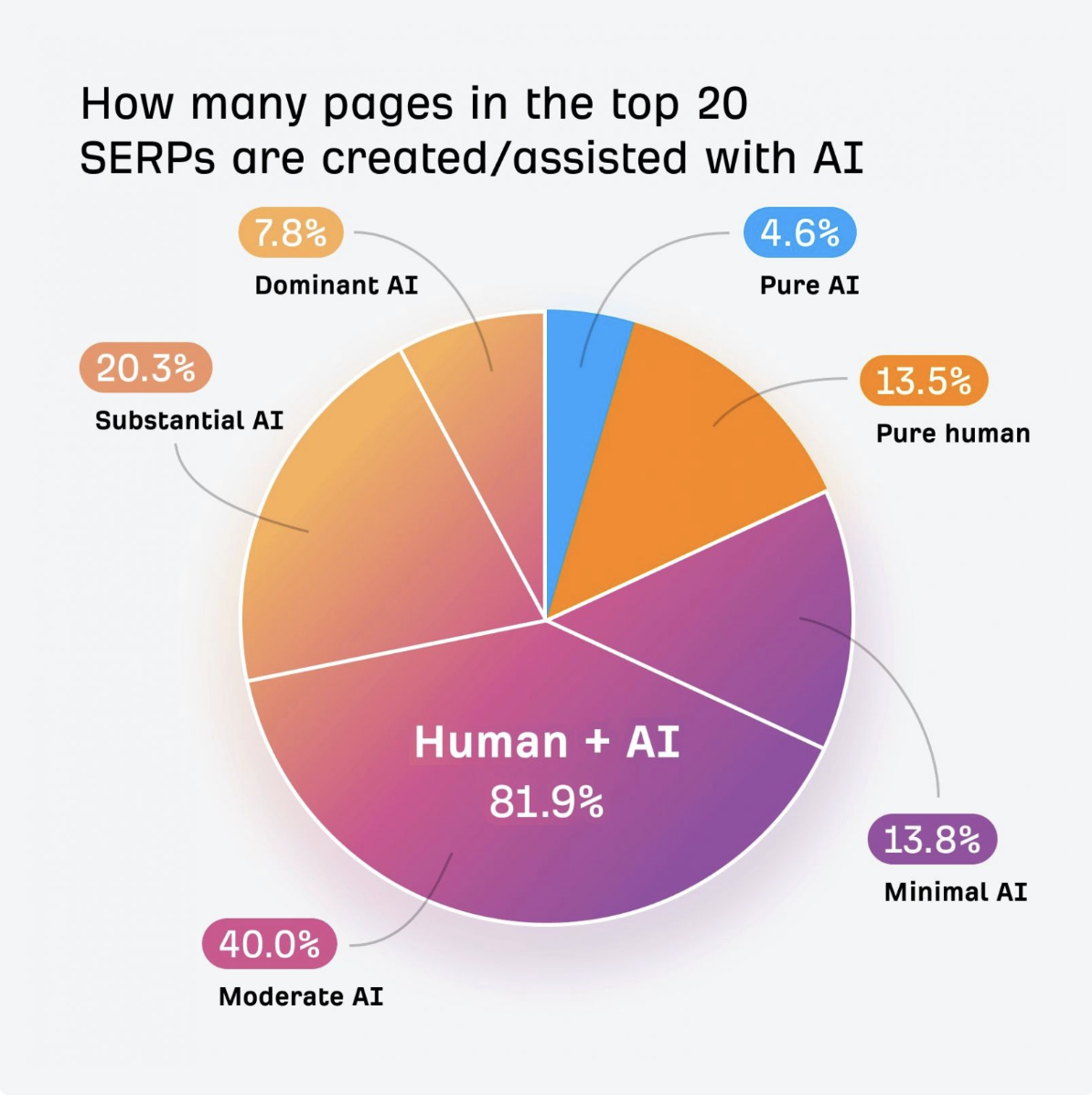
Last year, Ahrefs, an SEO marketing agency, conducted a large-scale site audit test of the highest-ranking websites.
ahrefs blog, Mateusz Makosiewicz
Dominant AI websites appeared in high rankings at 7.8%. Pure AI was 4.6%. Yikes.
81.9% of high-ranking websites were created with a blend of Human and AI, aka AI-assisted content.
According to WIX’s SEO Hub, risk-free AI assistance looks like this:
Task automation
Ideation and outlining
Non-creative content creation like graphs or statistics
Editing and proofreading*
I’m personally afraid AI watermarks will follow me into my late career as a website copywriter, but use AI to proofread at your own risk.
So, in conclusion, as long as a human is the one directing creative decision-making and the final voice— you should be in the clear, folks!
For now…..

This leads me to my third finding:
New technologies and anti-AI ideologies make the future of AI assistance for founders blurry.
A pushback caused by collective paranoia, not knowing what’s real or what’s not, has led to technology start-ups popping up like magic mushrooms in a wizard’s forest to address the issue.
The most prominent start-up is Pangram, an AI Detector Tool.
This is the industry’s gold standard AI text and image detector, increasingly popular among media publishers, research organizations, and educators. According to Wired, a recent New York Times “Modern Love Column” installment was found to be entirely AI-generated. Its Pangram score was 100%.

Sorry, New York Times and high school students avoiding their copy of Crime & Punishment, Pangram is the new sheriff in town.
Add Pangram’s free Chrome extension here. (Not sponsored; I just believe in human creatives, sue me! (Please don’t)).
And, of course, I cannot step away from my laptop without mentioning an important intangible extra argument.
So here’s my bonus argument:
Many young people hate AI.
I have seen many youngsters click out of websites or articles featuring AI-generated images, instantly losing trust in the site’s authority.
AI usage percentages might affect brand loyalty, especially among younger demographics.
Substack articles like The Imminent Enshittification of the Internet show how frustrated readers are with slop. We seem to be in our own post-2020s Space Race, obsessed and invigorated by scientific possibility rather than Earthly issues.
Here’s an Earthly issue: cleaning my apartment.
When I’m washing my dishes, I wonder why that process hasn’t been automated, instead of the heartbeat of humanity: writing. So, magical biz-owners, I’ll leave you with this.
Don’t let your Google rankings fall into the slop wormhole without even realizing:
Let’s use AI to clean up our messes, not create them.